Blog
Hormonal hair loss: does hair grow back in cases of hormonal hair loss?
Is your hair falling out? You don’t have to feel alone – male hair loss is a common problem that affects more than half of all men by the time they reach their 40s.
Androgenetic alopecia, or hormonal hair loss, is one of the most common types of hair loss. In men, this condition is known as male baldness, whilst in women it is referred to as female-pattern hair loss. Symptoms of androgenetic alopecia include a receding hairline, thinning hair, and hair loss that also affects the crown of the head, or vertex.
In this article, we explain how and why androgenetic alopecia develops, and you can find out what treatments are available to help your hair regrow in cases of hormonal hair loss.
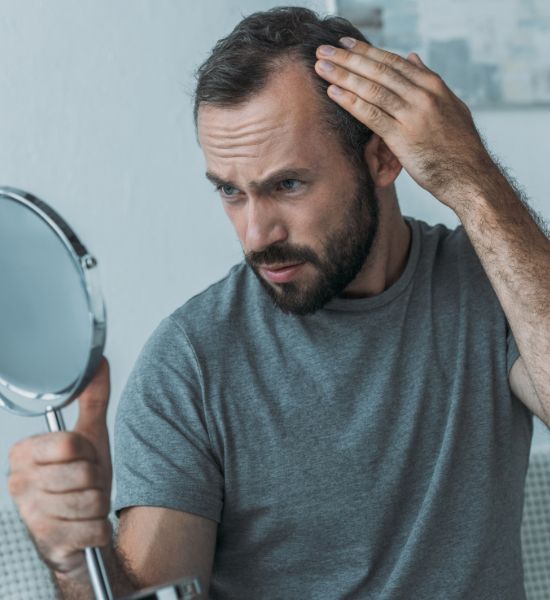
What is hormonal hair loss, also known as androgenetic alopecia?
Androgenetic alopecia, also known as pattern hair loss, is a type of hair loss caused by a combination of genetic and hormonal factors.
Characteristics of androgenetic alopecia:
- If you are suffering from androgenetic alopecia, you may notice that your hairline is receding and your hair is beginning to thin in an ‘M’ shape. Hair thinning can also occur on the crown of the head, but in women it most commonly manifests as thinning across the entire scalp.
- The hormone dihydrotestosterone (DHT) is responsible for this condition; in individuals with a genetic predisposition, it leads to a progressive deterioration in the condition of the hair follicles and thinning of the hair.
- Hormonal hair loss can be treated. There are currently several methods available that can slow down, stop, or even reverse the process of hair loss. Minoxidil treatments, for example, can help improve the condition of the hair, whilst the Denza laser hair treatment protocol can reverse hair loss.
- Hair loss caused by androgenetic alopecia generally worsens over time and with increasing age, so it is important to take action as soon as possible and begin treatment as soon as you notice the symptoms of hormonal hair loss.
- It is important to note that androgenetic alopecia is not the only cause of hair loss. There are various types of hair loss, such as alopecia areata, which is of autoimmune origin, or alopecia universalis, which can affect all body hair, as well as telogen effluvium, which is a sudden, diffuse form of hair loss affecting the entire scalp.
What causes hormonal hair loss?
Androgenetic alopecia is caused by the combined effect of several factors, including a genetic predisposition and the influence of male sex hormones, known as androgens: Androgenetic alopecia develops as a result of a genetic sensitivity to an androgenic hormone called dihydrotestosterone (DHT). How?
Your body produces DHT as a by-product of testosterone. DHT plays a key role in the development of male sexual characteristics during foetal development and puberty, for example in the development of the external genitalia, facial hair and the prostate.
However, as we age, DHT can also affect other things. DHT can damage hair follicles, leading to their progressive deterioration, or ‘miniaturisation’. Hair strands affected by DHT become thinner and shorter, and the structure of the hair becomes more brittle; and eventually the hair follicles may cease producing new hair altogether, resulting in significant hair loss and balding. In addition, DHT shortens the hair’s growth (anagen) phase, which means the hair has less time to grow, so the length of the hair strands also gradually decreases.
Some people are more sensitive to the effects of DHT than others, so genetics plays a key role in hair loss. If you are more sensitive to DHT, the process of hair loss may begin as early as your teenage years or in your twenties. For people who are less sensitive to DHT, hair thinning only becomes noticeable much later.
Research suggests that men with male hair loss generally have higher DHT levels than their peers, and there are more androgen receptors in their scalps.
Causes of hormonal hair loss in women
There are certain conditions that make women more likely to experience hormonal hair loss. These include a metabolic disorder known as PCOS, which is associated with a disruption in hormonal balance; as a result, the increased levels of androgenic hormones can trigger androgenetic alopecia. Furthermore, the hormonal imbalance that occurs during the menopause can also result in a predominance of male sex hormones, which may likewise trigger hormonal hair loss.
Can hormonal hair loss be prevented?
Male baldness is like height: it is encoded in our DNA from the moment we are born, and there is little we can do to change it. Studies involving pairs of twins have shown that around 80% of baldness can be attributed to genetic factors. The remaining 20% is down to a combination of hormones, lifestyle and environmental factors.
If you notice your hair thinning, or if there is a history of significant hair loss spanning several generations in your family, the best thing you can do is to start treatment for androgenetic alopecia as soon as possible.
It is generally much easier to retain the hair you already have than to regrow the hair you have already lost, as hair loss treatment is primarily aimed at preventing further hair loss. With Denza laser hair treatment, the process of hair loss can not only be slowed down, but also completely reversed. And with maintenance treatments, you won’t have to worry about hair loss ever again.
Hormonal hair loss: will the hair grow back in this case?
If you’re not sure how hair loss treatments work, or if you’re wondering how long the results of a hair loss treatment last, you’re not alone.
Topical treatments, such as minoxidil, can deliver impressive results after around 9–12 months of use. However, it is important to note that these treatments only work as long as you continue to use them. If you’re looking for a solution that restores your hair’s health quickly and in the long term, you’ll need more than just topical treatments.
The Denza laser hair treatment protocol delivers visible results after just the first few sessions, combining modern laser treatments with effective active-ingredient therapy and topically applied formulations. Thanks to this unique, comprehensive protocol, you can quickly and permanently restore your hair to health. Denza laser hair treatment is also exceptionally effective in cases of hormonal hair loss: not only does the hair regrow, but it also remains healthy and strong.
A denzahair.hu oldalon található információk és szolgáltatások nem helyettesítik a szakemberrel való konzultációt és kivizsgálást.
A kezeléstől várható eredmény egyénenként eltérő, azt számos tényező – így a páciens egészségügyi állapota, hormonális zavarok, vitamin-, ásványi anyag- vagy nyomelemhiány – befolyásolhatja, így az eredmény nem garantálható.


